





































What is data mining?
Data mining is the systematic analysis of large volumes of data to identify hidden patterns, trends, and relationships and use them as a basis for informed business decisions. It combines methods from statistics, computer science, and machine learning into a structured analytical process that can help companies make informed decisions efficiently. Bissantz offers data-mining methods designed for business users to analyze key business metrics.
| Characteristic | Details |
| Category | Data analysis / business intelligence / statistics |
| Application | Systematic analysis of large volumes of data for pattern recognition and decision support |
| Typical areas of application | Finance, marketing, healthcare, manufacturing, logistics, e-commerce |
| Related terms | Business intelligence, predictive analytics, machine learning, anomaly detection, big data, clustering |
| Benefits | Informed decisions, early warning systems, personalization, efficiency gains, fraud detection |
At a glance
Analyzes large datasets to identify patterns, trends, and relationships.
Typical methods include classification, clustering, association analysis, regression analysis, and anomaly detection.
Used in marketing, finance, healthcare, and logistics to increase efficiency, detect fraud, and enable personalization.
Provides a foundation for predictive analytics and data-driven business management.
Data mining definition
Data mining describes the process of systematically analyzing large datasets to identify patterns, trends, and relationships. The goal is to derive useful insights from raw data that can be used for strategic business decisions, enabling predictions and the early detection of developments.
Data mining lies at the intersection of statistics, computer science, and database management. It is an essential component of modern business intelligence processes and provides the analytical foundation for predictive analytics, machine learning, and data-driven business management.
How does data mining work?
The data-mining process begins with data preparation. Data is collected from various sources and cleaned to ensure that it is complete and accurate. Data mining is based on the use of algorithms and datasets. Analytical tools and algorithms are used to examine datasets for patterns and anomalies. In addition to computer science and statistics, data mining uses mathematical analyses to uncover patterns, trends, and relationships in datasets. The data is cleaned, transformed, and converted into a usable format before the analysis is performed.
Data-mining techniques typically operate as part of a cyclical process. Common steps include:
Data cleaning and transformation: Data is structured so that it can be processed efficiently.
Algorithm selection: The appropriate analytical method is selected based on the type of data and the question being addressed.
Model building and evaluation: The selected model is trained and adapted based on the data.
Validation and interpretation: The results are validated and translated into actionable insights.
What data-mining methods are there?
Data mining uses a range of different methods. The most common include:
| Method | Description | Typical application example |
| Classification | Assigning data to predefined categories | Credit assessment, spam detection |
| Clustering | Grouping data into similar clusters without predefined categories | Customer segmentation, market analysis |
| Association analysis | Identifying relationships between variables | Market basket analysis, cross-selling |
| Regression analysis | Predicting numerical values based on dependencies | Sales forecasting, price development |
| Anomaly detection | Identifying unusual patterns that deviate from the norm | Fraud detection, quality control |
Data mining in practice: examples of applications
Data-mining methods offer a wide range of applications across different industries:
Finance: Data mining is used in finance for fraud detection and risk assessment.
Healthcare: In healthcare, data mining makes it possible to analyze patient data and identify patterns that can contribute to improved diagnostic and treatment methods.
Marketing and e-commerce: Data mining is used to analyze customer behavior in order to develop targeted marketing campaigns and optimize product placement.
Manufacturing and logistics: Data mining is used in manufacturing to reduce failure rates and maximize supply-chain efficiency.
Social media: Data mining is used in social media to help companies identify sentiment and trends and assess the impact of brand messaging.
Benefits and challenges of data mining
Benefits
Increased efficiency: Data mining helps companies optimize processes and reduce costs by identifying bottlenecks and inefficiencies.
Informed decisions: Data-driven insights enable companies to base their strategies more effectively on facts.
Personalization: In marketing and customer service, data mining enables more personalized communication and improved customer experiences.
Early warning systems: Irregularities and trends can be detected at an early stage, which is critical for fraud detection and risk assessment.
Challenges
Data privacy: Handling sensitive data requires strict security measures and compliance with data protection regulations.
Data quality: Poor data quality can lead to misinterpretation, making thorough data cleansing essential.
Complexity and expertise: Building and maintaining data-mining systems requires specialized expertise in data science and programming.
Interpretation of results: Data mining produces large amounts of information that must be transformed into meaningful insights, requiring careful interpretation.
Data mining and Bissantz
DeltaMaster from Bissantz integrates data-mining methods into a comprehensive business intelligence solution that combines analysis, planning, and reporting. The software automatically identifies patterns and anomalies in data, highlights them visually, and makes them available to users at all decision-making levels.
Typical methods such as classification, regression, anomaly detection, and association analysis are not isolated tools, but are integrated into an end-to-end solution with dashboards, automated KPI logic, and visualizations. This gives companies immediately usable insights – without manual preparation or complex modeling.
Practical example: A retail company uses DeltaMaster to automatically identify deviations in sales data. Unusual declines in sales in individual regions or product groups are immediately flagged by anomaly detection. The controller can see at a glance where action is required and navigate to the root cause in just a few clicks using drill-down analysis. What previously required manual analysis now runs automatically and in real time.
FAQ – frequently asked questions
Data mining is like searching through a huge haystack for needles – except that the needles are patterns, trends, and relationships in data. Algorithms automatically search large volumes of data and uncover what may remain hidden from the human eye.
Business intelligence provides structured reports and KPIs – it shows what has happened. Data mining searches raw data for hidden patterns and relationships that are not immediately apparent. BI often uses data-mining results as a basis for analyses and dashboards.
Not quite. Data mining is an analytical process aimed at identifying patterns in existing data. Machine learning is a method in which models learn from data and make predictions. Machine learning is an important technique used in data mining, but data mining also includes statistical and rule-based methods that do not involve machine learning.
A critical one. Incorrect, incomplete, or inconsistent data can lead to false patterns – the so-called “garbage in, garbage out” principle. Data cleansing and preparation are therefore among the most demanding and critical steps in the entire data-mining process.
DeltaMaster integrates data-mining methods directly into the BI process: anomaly detection, pattern recognition, and automated variance analysis run in the background and provide controllers with immediately actionable insights – embedded in dashboards and reports.
Summary
Data mining is an analytical foundation of data-driven business management: it makes hidden patterns, trends, and relationships in large volumes of data visible and thereby provides the basis for informed decisions, early warning systems, and personalization. With DeltaMaster, Bissantz seamlessly integrates data-mining methods into business intelligence and controlling – automated, visually presented, and immediately relevant for decision-making.
Free of charge for you
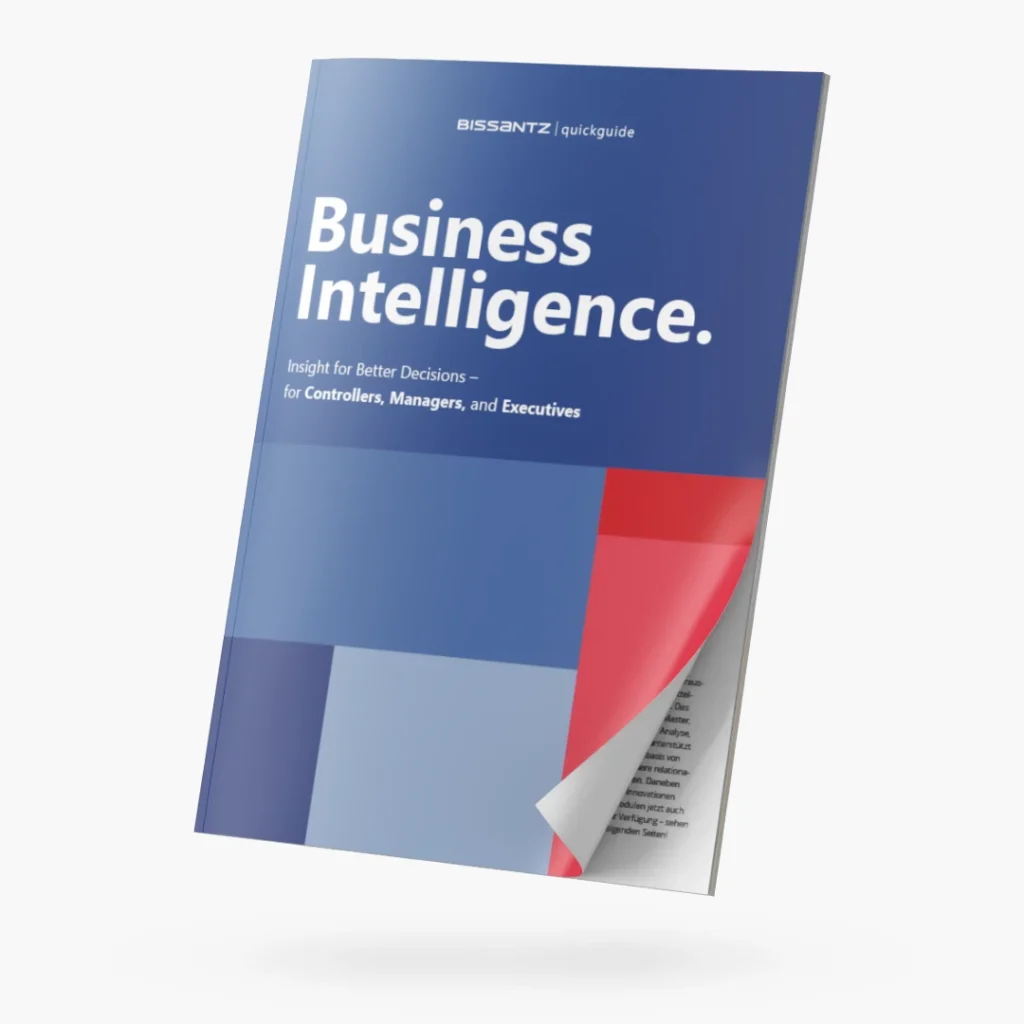
Quickguide "Business Intelligence" – download now!