






























What is a data platform?
A data platform is a central IT infrastructure that collects, stores, processes, and makes data from multiple source systems available for analysis, reporting, and planning. It provides the technical foundation for business intelligence and controlling across the organization. Bissantz supports companies in building and successfully using data platforms, with the goal of turning data into well-founded decisions.
| Feature | Description |
| Category | Data infrastructure |
| Applications | Collecting, storing, processing, and providing access to corporate data |
| Typical areas of use | Business intelligence, controlling, reporting, planning, data science |
| Related terms | Data warehouse, data lake, data lakehouse, ETL, ELT |
| Benefits | Unified data foundation, faster analysis, well-founded decisions |
At a glance
Brings together data from different source systems in one place.
Creates a unified, reliable data foundation for the entire organization.
Supports analysis, reporting, and planning alike.
Typical components include data integration, storage, data processing, and an access layer.
Business intelligence solutions such as DeltaMaster build on data platforms and use them to deliver analysis and decision support.
Data platform: definition and classification
A data platform encompasses the technologies, processes, and rules a company uses to bring together data from different source systems, store and process it, and make it available for analysis. It is not a single piece of software, but an infrastructure that connects multiple components, including data integration, storage, and an access layer.
Within an organization, the data platform serves as an intermediary layer. It sits between operational source systems such as ERP or CRM and analysis tools for business intelligence, controlling, and planning, such as DeltaMaster. Without this intermediary layer, analytical tools would have to access many individual source systems directly, which can negatively affect performance, data quality, and maintainability.
What is a data platform needed for?
Companies need a data platform because, in practice, data is distributed across many different systems: ERP and CRM systems, Excel files, online stores, and machines each generate their own datasets. Without a shared platform, this data remains isolated, inconsistent, or simply difficult to find.
A data platform brings these sources together and processes the data so that controlling and business departments work with the same figures. This prevents discussions about which metric is the “right” one and accelerates decision-making because analyses no longer have to be laboriously compiled first.
The benefits are particularly clear in controlling: A well-structured data platform is the foundation for reliable reporting, planning, and analysis.
What are the components of a data platform?
A data platform typically consists of several layers that together map the flow of data from the source to the analysis.
Data integration: Interfaces and ETL or ELT processes retrieve data from source systems such as ERP or CRM and transfer it to the platform.
Storage: Data can be stored in a structured format, for example in a data warehouse, or in an unstructured format, for example in a data lake.
Processing: Data quality rules, data cleansing, and data modeling ensure that metrics are calculated consistently.
Access layer: Reporting and analysis tools such as DeltaMaster use this layer to access the processed data.
Governance and security: Access controls and documentation define who is authorized to use which data and under what quality standards.
Data platform, data warehouse, and data lake: what is the difference?
The terms are often used interchangeably, but they refer to different things. A data platform is the overarching framework; a data warehouse and a data lake are possible components within that framework.
| Term | Type of data | Typical use | Strength |
| Data platform | Structured and unstructured | Enterprise-wide infrastructure for analysis, reporting, and planning | Combines multiple data sources and technologies |
| Data warehouse | Structured, pre-modeled | Reports and metrics requiring high data quality | Consistent, validated figures |
| Data lake | Structured and unstructured, often in raw format | Large datasets, exploratory analysis | Flexibility in data formats |
| Data lakehouse | Combination of a data warehouse and data lake | Analysis and reporting on a shared foundation | Combines flexibility and data quality |
What types of data platforms are there?
Data platforms can be differentiated by where they are operated and by their technical architecture. This classification helps companies select the right solution for their needs.
Cloud data platform: The infrastructure runs with a cloud provider and is consumed as a service. Storage and computing resources can be scaled flexibly and independently of one another.
On-premises data platform: The infrastructure runs on the company’s own servers. This provides full control over hardware and data, but requires in-house operational expertise.
Hybrid data platform: Some data and applications run in the cloud while others remain on-premises. This approach is suitable when certain data must remain in the company’s own data center for regulatory or technical reasons.
Analytical data platform: The focus is on analysis, reporting, and planning, as is typical for business intelligence and controlling.
Operational data platform: The focus is on running applications and day-to-day operations, such as online stores or production systems, rather than on analysis.
What are some examples of data platforms, and how do they differ?
Various technologies have become established in the market as data platforms. They differ primarily in how storage and computing resources are organized and how strongly they are designed for cloud deployment.
Snowflake: A cloud data platform that strictly separates storage and computing. Companies pay separately for data storage and computing resources, making costs more predictable.
Databricks: A platform that originally emerged from big data processing and is now positioned as a data lakehouse. It combines the flexibility of a data lake with capabilities for structured analysis.
Microsoft Fabric: A Microsoft cloud data platform that combines data integration, data warehouse, data lake capabilities, and reporting in a shared environment.
Google BigQuery: A cloud data warehouse from Google designed to handle very large datasets and deliver fast queries without requiring users to manage their own servers.
Amazon Redshift: A cloud data warehouse from Amazon Web Services that integrates with the broader AWS ecosystem and is often used by companies that already rely on other AWS services.
SAP BW/4HANA: A data warehouse from the SAP ecosystem that is closely integrated with SAP ERP systems and is used by many existing SAP customers as a data foundation for reporting.
These technologies differ in operating model, scalability, and depth of integration with existing system landscapes.
| Example | Operating model | Primary focus | Key characteristic |
| Snowflake | Cloud | Data warehouse | Separation of storage and computing |
| Databricks | Cloud, partly hybrid | Data lakehouse | Origin in big data processing |
| Microsoft Fabric | Cloud | Data platform with warehouse and lake capabilities | Combines multiple services in one environment |
| Google BigQuery | Cloud | Data warehouse | Very high scalability without managing your own servers |
| Microsoft Azure | Cloud | Data warehouse | Close integration with the AWS ecosystem |
| SAP BW/4HANA | On-premises or cloud | Data warehouse | Close integration with SAP ERP systems |
Cloud data platform or on-premises: which is right for your company?
The choice between a cloud, on-premises, or hybrid data platform depends on factors such as data volume, available IT resources, and regulatory requirements.
| Criteria | Cloud data platform | On-premises data platform |
| Scalability | Flexible, can be adjusted quickly | Limited by available hardware |
| Operational effort | Lower because the provider manages operations | Higher, requiring in-house personnel |
| Cost model | Usage-based, ongoing costs | Investment-based, higher upfront costs |
| Data control | Data is hosted by the cloud provider | Full control within the company’s own data center |
| Typical use | Growing data volumes, changing requirements | Strict regulatory requirements, existing infrastructure |
Which solution is right for my use case?
The right type of data platform depends on the specific requirements. For controlling and reporting with high data quality requirements, a data warehouse is often well suited as the core of the data platform. Companies with very large or highly unstructured datasets often complement it with a data lake or use a data lakehouse.
Companies with an existing SAP system landscape often consider an SAP-oriented solution such as SAP BW/4HANA first, while companies with heterogeneous system landscapes tend to favor vendor-neutral cloud data platforms such as Snowflake or Microsoft Fabric.
In every case, the key is to ensure that the selected data platform connects to the existing source systems and can provide business intelligence tools such as DeltaMaster with data efficiently. Bissantz advises companies on which data platform best fits their existing systems and analytical objectives.
What are common mistakes when implementing a data platform?
Companies repeatedly encounter similar challenges when implementing a data platform.
Poor data quality: If data is imported without validation, inconsistent metrics can result. Assigning clear responsibility for data quality and establishing consistent metric definitions can prevent this.
Too many isolated solutions: If departments continue to maintain their data separately, the benefits of the platform remain limited. Gradually connecting all relevant source systems helps prevent this.
Lack of governance: Without clear access rules, security risks and inconsistent analyses can arise. Establishing a governance framework from the outset creates clarity.
Overly technical focus: If the platform is designed purely from an IT perspective, it often lacks a connection to controlling and the business departments. Involving business teams early on helps ensure practical usability.
Underestimating migration: Migrating existing reports and metrics to a new data platform is often given too little time. A realistic migration plan with a testing phase reduces this risk.
Lack of a scaling strategy: If the data platform is designed only for current requirements, growing data volumes can quickly push it to its limits. A forward-looking architecture takes foreseeable growth into account from the outset.
Data platforms and Bissantz
The relationship between Bissantz and data platforms is twofold: On the one hand, Bissantz supports companies in the selection, implementation, and use of various data platforms. On the other, Bissantz provides decision intelligence software that accesses data platforms to turn data into clear insights and decision support.
Practical example: A company with multiple ERP systems and individual Excel analyses wants to introduce Microsoft Fabric as its central data platform, but does not know what the right target architecture should look like. With Microsoft Fabric consulting from Bissantz, the company builds a high-performance medallion architecture and can begin using its data reliably for analysis, planning, and reporting within a short time. As part of the project, the company also decided to use Bissantz for its analytical front end: DeltaMaster connects seamlessly to Fabric and enables automated data analyses.
FAQ: frequently asked questions
A data platform is a central place where a company collects and processes all its important data. Instead of gathering figures from many individual systems, reporting and analysis can access a shared, validated data foundation.
A data platform is needed to bring together data from different source systems and make it usable for analysis. It prevents inconsistent metrics and accelerates reporting, analysis, and planning across the organization.
A data warehouse stores pre-modeled, structured data for reports and metrics. A data platform is the overarching framework that can include a data warehouse, a data lake, or both as components.
A cloud data platform is operated by an external provider and can be scaled flexibly, while an on-premises data platform runs on the company’s own servers and provides full control over the hardware.
Well-known examples include Snowflake, Databricks, Microsoft Fabric, Azure, Google BigQuery, Amazon Redshift, and SAP BW/4HANA. They differ primarily in their operating models and in whether their focus is on data warehousing or data lakehouse capabilities.
Bissantz connects to a company’s data platform and makes the data it contains immediately available to business teams as reports, analyses, or planning applications. This allows controlling and management to benefit directly from a well-structured data platform.
Summary
A data platform brings together corporate data from different source systems in one place, creating the foundation for reliable reporting, analysis, and planning. Whether implemented as a data warehouse, data lake, data lakehouse, cloud solution, or on-premises infrastructure, the key is to establish a unified, validated data foundation. Bissantz consulting helps companies make effective use of data platforms and get the most out of their data.
Related terms: deepen your knowledge
Free of charge for you
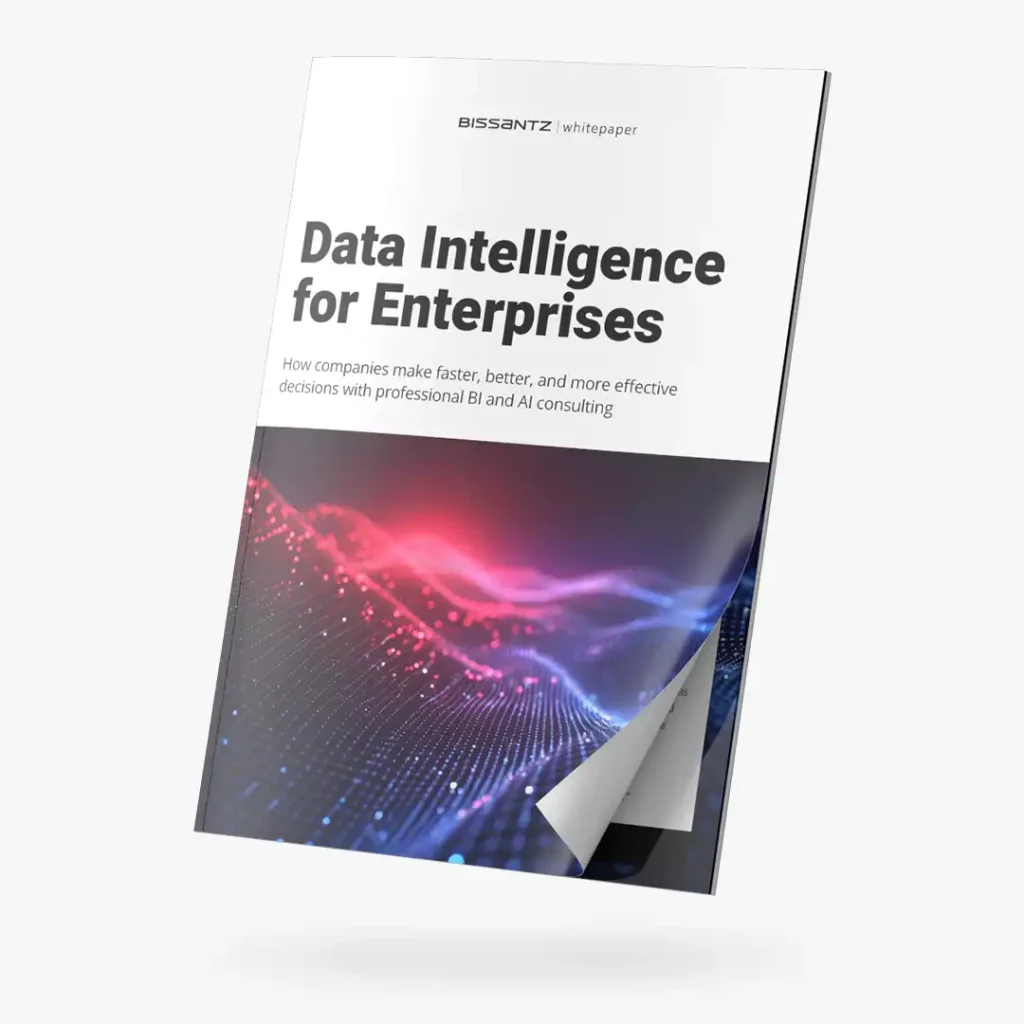
How companies make faster, better, and more effective decisions with professional BI and AI consulting