









































Design today faces a new, urgent demand: it’s less about form, style, or aesthetic distinction, but about orientation – in a world that has become more complex, faster, and more contradictory. This shift was clearly evident at the German Design Award 2026, which took place on February 6 in Frankfurt. The recognition of Bissantz’s DeltaApp fits into this context.
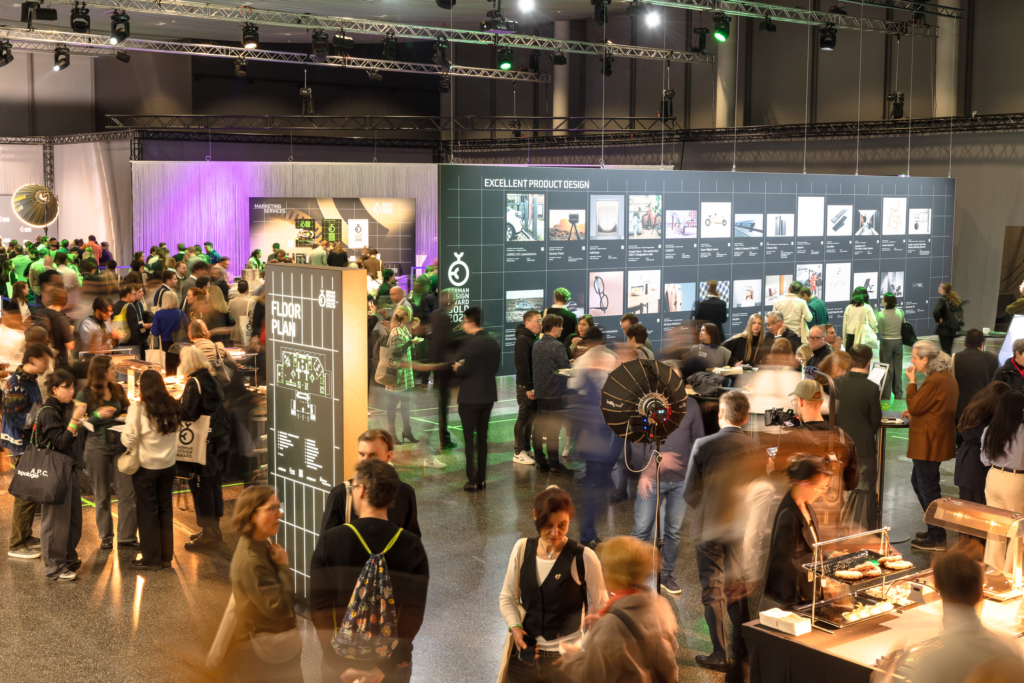
Award ceremony on February 6, 2026 in Frankfurt (© German Design Council 2026)
Above all, the question arises: How can companies and people succeed in an environment shaped by geopolitical tensions, technological disruptions, artificial intelligence, sustainability requirements, and growing decision-making pressure? The answer running through many awarded contributions was remarkably clear: through good design—understood as a tool for thinking and acting.
The right question is crucial
One of the key strengths of designers is asking the right questions. In complex systems, what matters is not the quantity of information, but its relevance. Design thinking as a working principle describes precisely this ability: highlighting what’s essential, bringing perspectives together, and making complexity manageable. For users, this means understanding more quickly what matters, deciding more confidently, and acting more coherently. This benefit becomes especially visible in the context of business intelligence. Drawing the right conclusions rarely fails due to missing data, but because relevant signals are lost in the noise when everything appears equally important.
Reduction creates orientation
A central motif of many awarded works was therefore conscious reduction: less visual noise, clearer structures, more intuitive interaction. In product design, service design, and digital applications, it repeatedly became apparent: orientation doesn’t emerge through more information, but through better weighting.
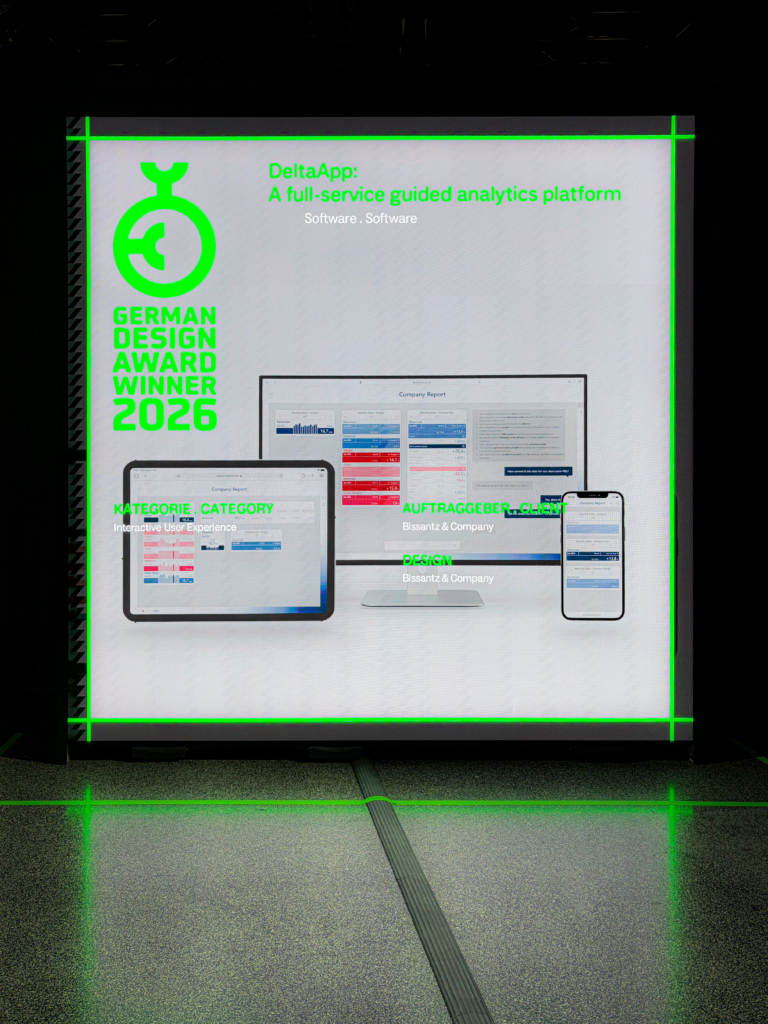
The DeltaApp by Bissantz, awarded the German Design Award 2026, on a large display at the award show in Frankfurt
AI-generated content may contain errors. Against this background, the jury recognized DeltaApp by Bissantz & Company in the category Excellent Communications Design – Interactive User Experience. Highlighted were, among other things, the reduction to essentials, typographically scaled numbers, sparingly used color, intuitive gesture navigation, and meaningful sparklines. These elements are guided by a simple question: What can a person grasp at a glance—and what supports them in making coherent decisions?
Good design brings order to numbers
This question crystallized for us in an encounter with designer Naoto Fukasawa, honored by the German Design Council as “Personality of the Year.” His statement that design should counter nature’s chaos with human order, without completely dissolving this chaos, led us to ask a follow-up question: How does this idea apply when designing the abstract, namely numbers, which only gain meaning in context?
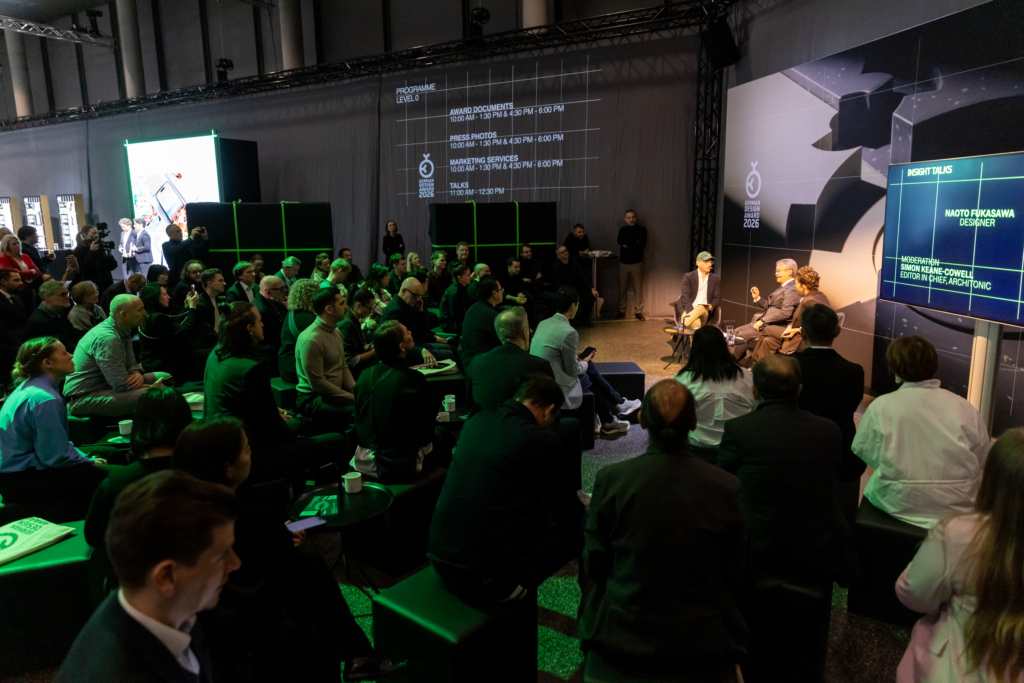
Panel talk with designer Naoto Fukasawa (© German Design Council 2026)
After brief reflection, Fukasawa’s answer was surprisingly simple: Design should give the user a feeling of happiness.
What sounds poetic at first describes a very concrete relationship. Good design empowers. It helps people see and understand information in ways that correspond to their cognitive and emotional prerequisites. When connections become clearer, decisions more confident, and actions more comprehensible, self-efficacy emerges. And self-efficacy becomes visible in everyday work as a sense of achievement, as a form of “happiness” that is quiet but effective.
Design is part of analytical intelligence
In this sense, we understand the award not just as a design prize. It confirms an approach we’ve pursued at Bissantz for many years: design is an integral component of analytical intelligence. Anyone who analyzes and visualizes data must understand how perception works, where its limits lie, and how human attention is directed.
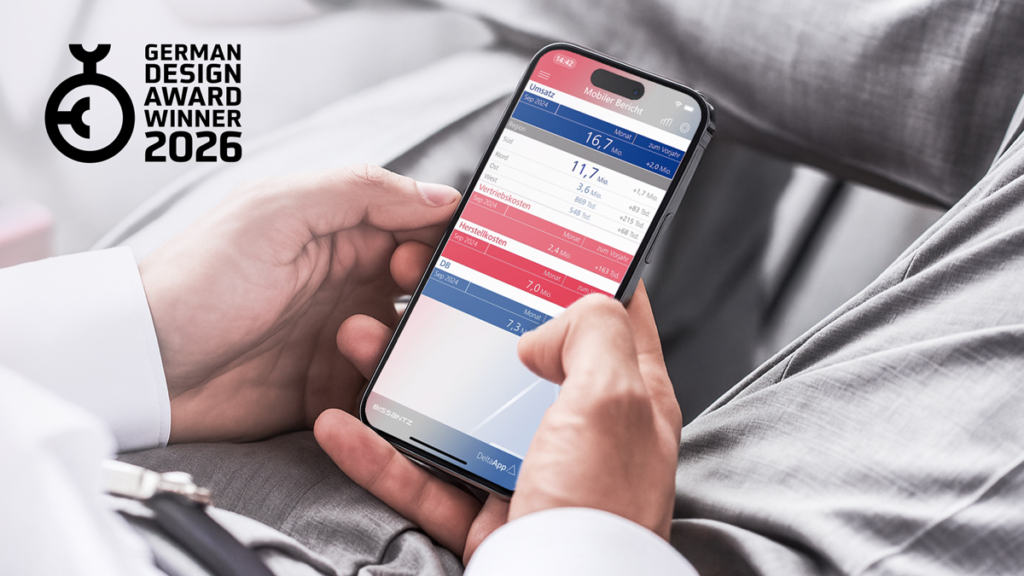
The most important metrics at a glance on smartphone
The design of DeltaApp follows precisely this understanding and aligns with users’ ways of thinking. Typographically scaled numbers replace chart areas, color codes relevance, gestures follow the logic of thought. We speak of haptic thinking: numbers are designed so that they naturally lead to the next thought.
In this sense, DeltaApp translates analytical questions into a visual and interactive logic that deliberately sets signals: What’s relevant? Where is action needed? And what next step follows from this?
The German Design Award shows: The standard for good design has shifted. It’s about orientation in complex environments. The most convincing works are often those that aren’t loud, but that lead—design that steps back to send clear signals and enable coherent action.
Award as a confirmation and mandate for Bissantz
The German Design Award joins a series of international awards for Bissantz & Company. Together they mark a clear stance: we develop analytical systems where design is part of the solution from the start.
At the same time, we understand this award as a mandate. Complexity will remain, data volumes will grow. All the more important becomes design that places people at the center—in their thinking and acting in a complex world.