









































Artificial intelligence opens up new possibilities in controlling while simultaneously bringing new requirements. Alongside technical feasibility, companies must also ensure that analyses remain reliable and decisions can be made responsibly. The focus is particularly on BI approaches based on consistent data models, clearly defined key figure logic, and traceable analysis processes—the approach taken by Bissantz.
AI in controlling: from experiment to productive use
Artificial intelligence is already being used in real business processes in many companies, including in controlling. In reports, forecasts, or ad-hoc analyses, results are generated quickly. At the same time, questions are being raised about their reliability and technical foundation.
Part of this uncertainty arises outside of controlling. Eerly experience with generative AI shows how quickly answers can be generated and how convincingly they are formulated. These impressions also shape expectations in controlling.
However, controlling places different demands on AI. Analyses are based on defined data models, clear key figure logic, and established reporting processes. They form the foundation for decisions and retain their central role even when using AI. At Bissantz, these structures serve as the starting point for the use of AI.
For BI and controlling professionals, this changes the focus. Alongside the potential comes the question of reliability. AI should support analyses without impairing traceability and control.
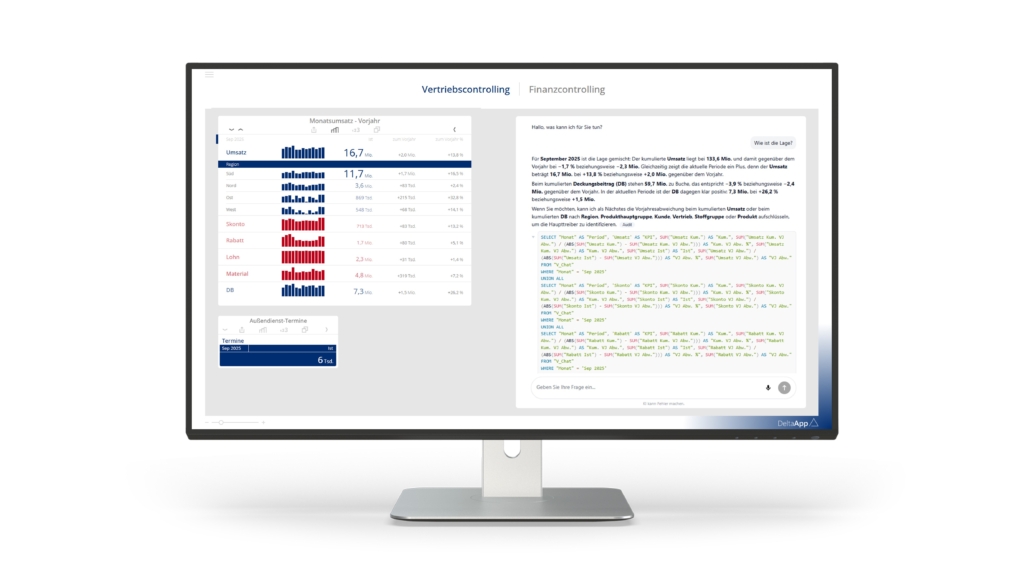
Audit Trail: AI source information ensures transparency and traceability for controlling and management
Compliance and risks when using AI in controlling
Compliance in AI deployment encompasses more than adherence to legal requirements. Legal security, organizational control, and economic responsibility closely interconnected.
In controlling, three central risk areas can be distinguished: liability risks through erroneous or non-traceable results, reputational risks through lack of trust in analyses, and economic risks through wrong decisions based on insufficient data.
When using AI, multiple regulatory frameworks often apply simultaneously. Considering individual requirements in isolation rarely provides a complete solution. It becomes particularly critical when results can no longer be traced. In such situations, existing control and governance processes reach their limits.
Many of these uncertainties are closely linked to expectations of AI deployment.
Myths about AI in controlling
Numerous expectations of AI in controlling arise from experiences with generative AI and can only be transferred to technical applications to a limited extent.
A common misconception concerns the evaluation of Excel files. While spreadsheets can be processed, complex data structures and business logic are not automatically interpreted correctly.
Forecasts are also frequently overestimated. AI can include additional influencing factors and recognize patterns, but remains dependent on assumptions and models.
Additionally, there is a structural difference: language-based systems formulate answers but do not perform independent, verifiable calculations in the sense of business metric logic. As a result, plausible statements do not necessarily stem from reliable analyses.
In controlling, what matters is the derivation of results from traceable data and defined calculations. At Bissantz, this derivation from fixed data models and key figure logic is the foundation of every analysis.
Transparency and control in BI
For the use of AI in controlling, transparency and control are central. Explainable AI describes the ability to make analysis results traceable.
In the BI context, this means that the analysis path can be fully reviewed. Results arise from defined data, queries, and calculations and not as isolated system responses.
A suitable architecture separates data storage, calculation logic, and AI functionality. Bissantz systematically implements this separation. The underlying metrics and data models remain unchanged. AI accesses these structures, orchestrates the analysis process, and presents the results in a transparent and understandable way. The calculation itself still takes place within the existing logic.
For each analysis, it is possible to see which data was used, which queries were executed, and how the results were derived. This ensures that the results remain reproducible and can be verified retrospectively.
To safeguard this, these steps are documented. An audit trail describes the analysis path of a specific query, while an audit log records the system’s overall use. Only together do they create a complete picture of usage and results.
Human-in-the-Loop ensures that responsibility remains with humans. AI supports analyses, but evaluation and approval remain the responsibility of domain experts.
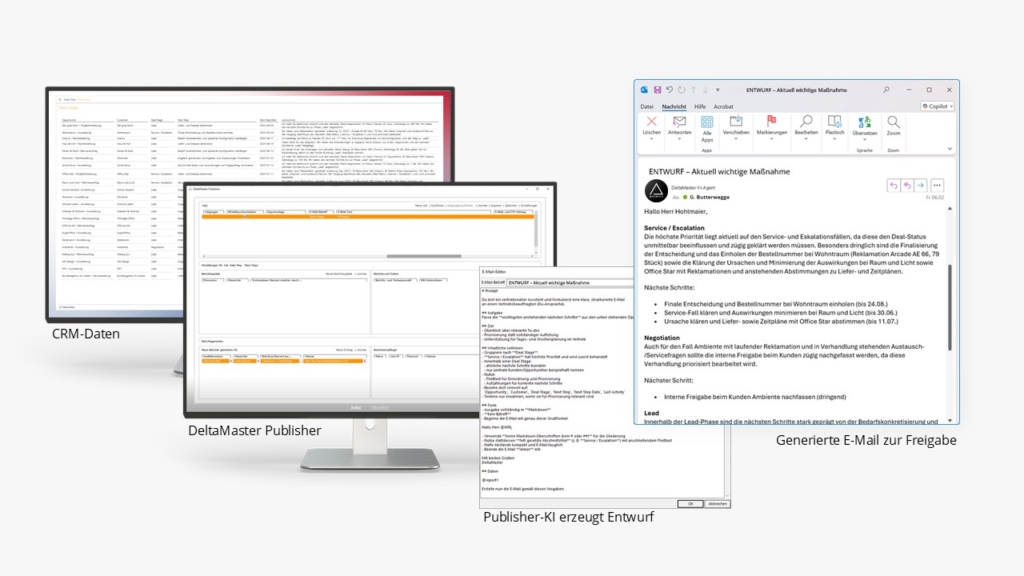
Human-in-the-Loop: Agentic AI in DeltaMaster Publisher – Drafts for approval
Data, security, and regulation
A key aspect is how data is handled. Company data remains in existing systems, and the information needed for analyses is provided in a targeted manner. The data foundation remains consistent, existing calculation logic continues to be used without change.
This also allows better control of requirements for data protection and data security. This approach is also relevant from a regulatory perspective. The EU AI Act pursues a risk-based assessment. Systems with transparent functionality, clear documentation, and human control can in many cases be classified as limited-risk applications. The approaches taken by Bissantz meet these criteria.
AI as an extension of business intelligence
Under these conditions, AI extends business intelligence specifically where conventional systems reach their limits. Analyses can be accelerated, questions formulated more flexibly, and connections recognized more quickly, without changing the technical foundation.
Metrics remain authoritative, calculation logic remains consistent, and data models remain the basis of every analysis. At Bissantz, these principles form the foundation for AI to meaningfully complement existing systems rather than replace them.
Conclusion
AI in controlling is not purely a technological question. At the center are reliable analyses, traceable results, and clearly assigned responsibility.
This is precisely where BI approaches come in that are based on consistent data models, clearly defined key figure logic, and transparent analysis processes. They create the prerequisites for AI to be used in a controlled manner and to fit into existing structures. Bissantz consistently pursues this approach, thereby providing the foundation for the productive use of AI in controlling.