





































Employees want more recognition. Bosses want more time. Can computers help? Could an avatar of the boss trigger the same emotions in employees as the real boss would? Perhaps. Here are my first thoughts about an idea that could fill motivational deficits among employees.
Following our Executive Forum in June, I toured a few galleries in Berlin. In Blain/Southern, I discovered the artist Nassan Tur. The exhibition hall, which once housed the printing presses of a major local newspaper, was very spacious. Nassan Tur filled it entirely. The two side walls were completely covered with 800 seemingly identical drawings in a regular grid. Each one showed a different spelling of the German word “Kapital”, a reference to Karl Marx’s book “Das Kapital” and the means of production. Nassan Tur had painted the words on paper himself. The combined work called “Variationen von Kapital” (English: “Variations of Capital”) was accompanied by a video which translates to “Bankers Say Capital”. Four monitors, which were placed vertically in a monolithic block, showed the faces of real bankers based in Berlin and Frankfurt. Larger than life and overly illuminated, they attempted to pronounce the different spellings of the word – Kapital, Kapitahl, Kaapital, Kappital, Khapital, and so on.
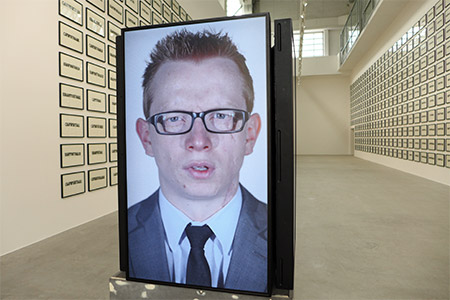
One day, you might see something similar in the office when the boss is waiting for success reports. An installation by Nassan Tur in the Blain/Southern Gallery, Berlin.
The gallery’s reception area is only a few meters away. I wasn’t the first person to ask the two ladies there what it is like to hear the same word about 10,000 times every day. Their response was that you get used to it and, over time, you don’t even hear it anymore.
That reminded me of a few more mundane examples. At a tradeshow once, I was welcomed in such a realistic way by an electronic woman wearing a lampshade on her head that I had trouble not greeting her back. At BMW Welt, BMW’s customer experience and exhibition facility in Munich, visitors are also welcomed by a life-sized master of ceremonies. In this case, however, he is displayed on a man-sized group of screens that is clearly recognizable as such. An illusionary effect, therefore, doesn’t seem intentional.
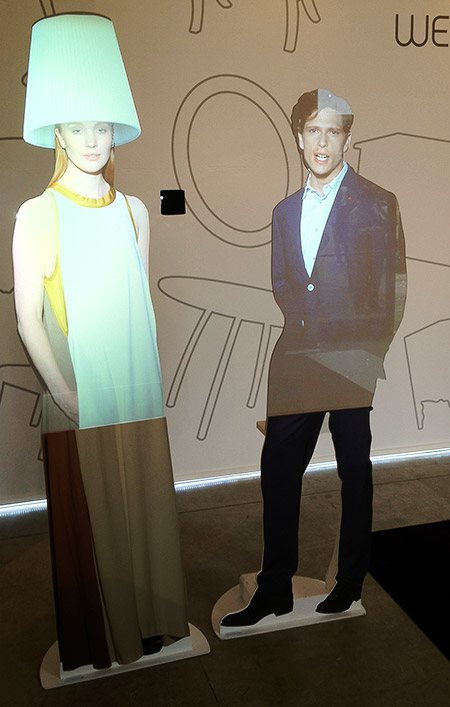
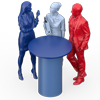
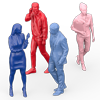
A projection of human silhouettes at a tradeshow.
The effect that had made the greatest impact on me to that point came from the clothing company Stone Island. For a tradeshow display, it had created a room completely covered in copper, and it looked as if the models were standing behind man-sized windows outside in a courtyard. They moved every once and a while, turning at 360 angles, to show how the creations of Stone Island looked on the models. In reality, there was no courtyard and the models weren’t present. You were watching videos on two monitors placed on top of each other, with the dividing frame clearly visible. Nevertheless, the illusion works in a striking way.
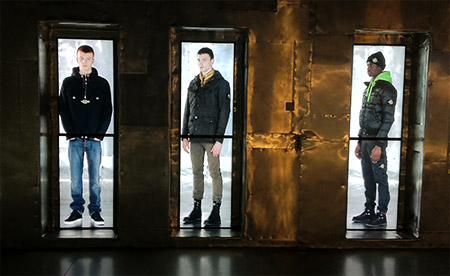
Video installation that make you believe to be looking at models standing around in a courtyard. (Tradeshow installation from Stone Island, 2012)
I spent about a half an hour in Nassan Tur’s exhibit. In that time, I must have heard Kaaappppitaaahl, Kappitall, Kahhhpitaaaal, and the likes thereof about 600 times. The acoustic bombardment had an effect. I left the gallery, my thoughts engrossed in economic questions. Back at home, I contemplated how my combined experiences with avatars fit together with my discussions with the brain researcher, Prof. Gerhard Roth. Roth was our guest speaker at our Executive Forum, so our most recent conversations were still fresh in my mind. Perception, as I had learned, follows universal laws. Individual variances are minimal. In other words, if I automatically look at and am fascinated by electronic people and faces that are larger than life, it is probably because certain mechanisms – that apply to us all – are in play.
How can we leverage this to effectively manage companies? More on that next time.